
Search for:
  • Home
  • Justice & Brain Injury
    • Brain Injury 101
    • Prevalence of ABI in the Criminal Justice system
  • Challenges & Strategies
    • Working with Vulnerable Persons
    • Creating Accessible Meetings
    • How to Host a Virtual Meeting
    • Communication Challenges and How to Address Them
    • Deescalation Tactics
    • Support and Soothing Tool Kit
  • Factors to Consider
    • Voluntary Statements
    • False Confessions
    • Bail
    • Courtroom Behaviour
    • Strategies to Get Relevant Information
    • Fitness to Stand Trial
    • Diversion and Specialize Courts
  • Resources & Printable Tools
    • Outils imprimable en français
    • Screening Tools
    • Printable Tools
    • Court Checklist
    • ABI Associations & More
  • Contact
  • phone 416-830-1485
  • email info@bist.ca
ABI Justice - Legal Experts
Return to Landing Page
  • Home
  • Justice & Brain Injury
    • Brain Injury 101
    • Prevalence of ABI in the Criminal Justice system
  • Challenges & Strategies
    • Working with Vulnerable Persons
    • Creating Accessible Meetings
    • How to Host a Virtual Meeting
    • Communication Challenges and How to Address Them
    • Deescalation Tactics
    • Support and Soothing Tool Kit
  • Factors to Consider
    • Voluntary Statements
    • False Confessions
    • Bail
    • Courtroom Behaviour
    • Strategies to Get Relevant Information
    • Fitness to Stand Trial
    • Diversion and Specialize Courts
  • Resources & Printable Tools
    • Outils imprimable en français
    • Screening Tools
    • Printable Tools
    • Court Checklist
    • ABI Associations & More
  • Contact

How to Host a Virtual Meeting (Video included)

folder_open Accessibility, Communication Strategies, Tech Tools & Tips
virtual-meetings image

There are some simple and effective strategies to consider prior to hosting a virtual meeting when working with vulnerable persons of any age. The following list can ensure the meeting is a success.

  1. Ensure your client has access to technology and platform ahead of time.
  2. Help your client to create a plan to ask for support or assistance to access location, technology or an internet connection for the meeting.\
  3. Ensure your client has time, date, and a reminder set up ahead of scheduled meeting.
  4. Provide client with agenda ahead of time and list of information they may be required to have for meeting.
  5. Ask support person to attend if possible and provide reminders and cueing to client
  6. Remind your client to be in a quiet location, use headphones to block out distractions
  7. Test platform with your client ahead of time to ensure they can use/access the platform
  8. Use a simple and easy to access platform. If possible, ask the client their preference, maybe more comfortable using a simple technology such as facetime or Whatsapp if applicable.
  9. Provide recording of meeting to client if allowed/possible for the client to review.
  10. Speak clearly and slowly as this may be difficult to follow for an individual with a cognitive impairment.
  11. Ask the client what time of day is best for their attention and focus Morning or afternoon
  12. Keep the information simple and concise and limit the number of participants to avoid overwhelming the client.
  13. Ask the client if they need a break.
  14. Keep meeting brief as virtual meetings can be cognitively fatiguing
  15. Remind client of steps, keeping muted to reduce background noise and distractions.
  16. Repeat information as necessary and ask client if they understand, ask client to repeat back.
  17. Be patient, set up cues with client if the client is feeling overwhelmed or confused. Eg. Raise hand to alert .
  18. Send client a summary of meeting notes via email, google drive or mail for their review and to track in their court binder/google drive.
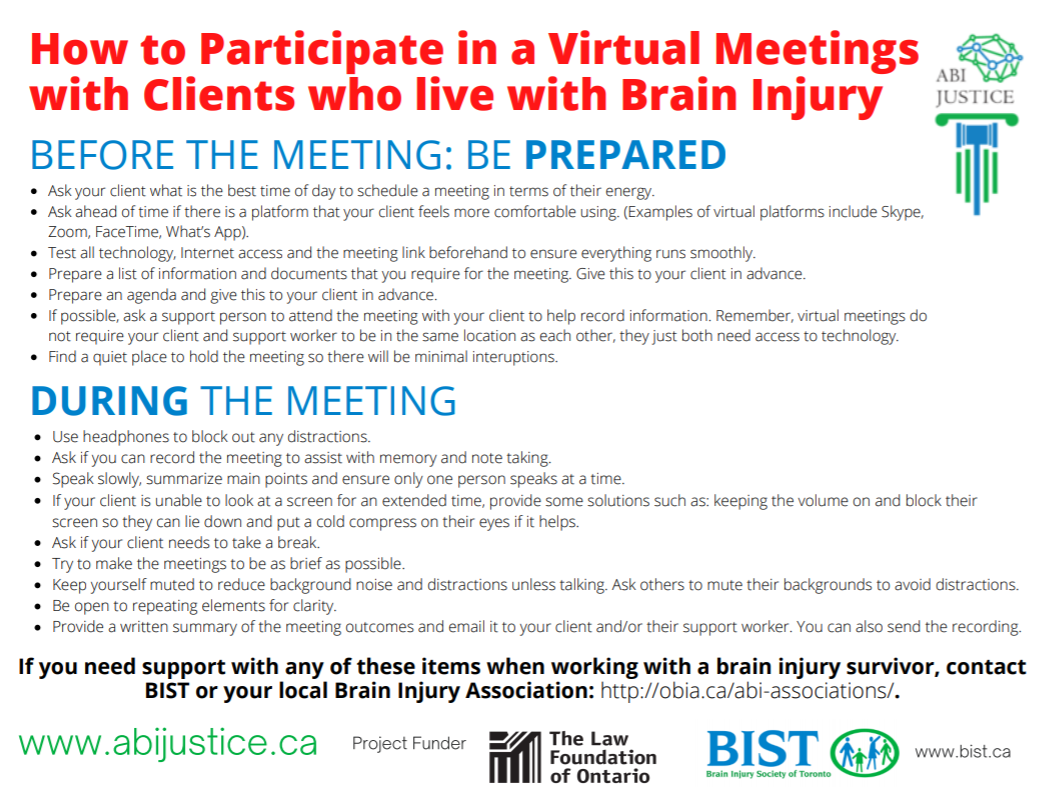
(Printable Version)

Tags: accessibilityCommunication StrategiesTech Tips and Tools
Search for:
Communication & Strategies
  • Working with Vulnerable Persons
  • Creating Accessible Meetings
  • How to Host a Virtual Meeting
  • Communication Challenges and How to Address Them
  • Deescalation Tactics
  • Support and Soothing Tool Kit

We are creating a provincial database of legal professionals who are knowledgeable on the intersection of brain injury and the justice system.

If you are interested in becoming a part of this database, please provide your contact details for more information and further training opportunities.

Sign up here, get involved

ABI JUSTICE LOGO - BRAIN INJURY LEGAL INFORMATION

ABI Justice is the first and currently
the only resource in Ontario that
aims to decrease common barriers
that become present for persons
with brain injury when faced with
legal matters.

  • location_on
    40 St. Clair Avenue East, Suite 205, Toronto, ON M4T 1M9
  • phone_android
    416-830-1485
  • email
    info@bist.ca
CONNECT WITH US…
NEWSLETTER

RESOURCES FOR LEGAL & BRAIN INJURY COMMUNITY
Legal Professionals Main Menu
  • Justice & Brain Injury
  • Challenges & Strategies
  • Factors to Consider
  • Resources & Printable Tools
Brain Injury Survivors Main Menu
  • Criminal Justice & Brain Injury
  • Criminal Court Proceedings
  • Where to Get Help
  • Printable Tools
TERMS OF USE

This website has been developed by the Brain Injury Society of Toronto and all information of any kind that is made available on or through this website is provided for general information purposes only and should not be taken as legal or medical advice, diagnosis or treatment recommendations. No information made on or through this website is intended to be a substitute for consultation, diagnosis, treatment, care, or advice provided by licensed health care, lawyer or other professionals. Although the information made available or through this website is reviewed carefully, it may be out of date and its accuracy or utility is not guaranteed. For more information, please visit our Terms of Use.

© 2020 ABI Justice – Legal Information for Brain Injury Survivors. All rights reserved. Terms of Use
Design by: Kre8iv
keyboard_arrow_up Skip to content
Open toolbar Accessibility Tools

Accessibility Tools

  • Increase TextIncrease Text
  • Decrease TextDecrease Text
  • GrayscaleGrayscale
  • High ContrastHigh Contrast
  • Negative ContrastNegative Contrast
  • Light BackgroundLight Background
  • Links UnderlineLinks Underline
  • Readable FontReadable Font
  • Reset Reset